Posts

Showing posts with the label france

Death in the Clouds - Agatha Christie

Image
Published by Agatha Christie Ltd/Planet Three Publishing: London. No date. First published 1935. Mystery novels are fun, but re-reading them can be less exciting. Well-written ones can still hold interest, but a lot of the fun is trying to figure out, along with the detective, just "whodunnit?" If you know whodunnit, it changes the game a bit. On the other hand, examples like Murder on the Orient Express and (I would suspect) The Murder of Roger Ackroyd might still be interesting on a second read, knowing the outcome, and looking for the clues that point in that direction. Perhaps, however, the way to enjoy re-reading a mystery is to leave long enough between reading and re-reading it. I first read Death in the Clouds in 2017, and in the nine years(!) since then, I seem to have forgotten enough of the plot to get sucked back in. In fact, I even became convinced that I remembered what happened, and ended up wrongly suspecting another character because of my faulty memory. Per...

Code Name Verity - Elizabeth Wein

Image
Published by Hyperion/Disney Book Group: New York, 2013 (2012). When I was training to be a teacher, this book was recommended by a particular vlog post we were directed to during one lesson. I hunted out a copy, read it, loved it, and started recommending it to others.  That was before I started my book list, so was at least nine years ago. Having finally picked it back up, I think I spent about the right amount of time between reads, because although I could remember some of the main beats, I was able to discover the specifics afresh and once again enjoy the process of discovery. The premise of Code Name Verity is quite sad: our Scottish (don't call her English!) protagonist (whom we eventually learn is named Julie), has been captured in Nazi-occupied France during World War 2, and is now being tortured and interrogated as a spy. In order to avoid further torture, as well as hopefully delay her execution, Julie has begun revealing secrets from her time with the Allies, starting w...

Timeline - Michael Crichton

Image
Published by Arrow Books Ltd/Random House UK Ltd: London, UK, 2000 (1999). A while ago, Elise and I borrowed three books from some friends. One of them was The Amazing Maurice and His Educated Rodents , I don't actually remember what the second one was (perhaps it was the Scarlet Pimpernel Omnibus ? Or, was that the book we lent to them in return?), and the third one was this one. The aim was that we would read these books together, but that only happened with the omnibus. The Amazing Maurice was briefly explored by both of us, but I carried it on solo, and this one had something similar: Elise and I read about 100 pages together, but it was a little slow for that combined reading, so in the end, I finished it off myself. Looking back through my blog, I realise just how long we had Timeline sitting around before even beginning it, and then it took another (shorter) period of time for me to decide to carry it on after Elise and I gave up on it... It's definitely about time we gi...

Quentin Durward - Sir Walter Scott

Image
Published by Thomas Nelson and Sons Ltd: Edinburgh, date unknown. First published 1823. Sir Walter Scott was an author who lived and wrote in the 18th and 19th century, and was one of the most popular authors of his day. He also was an author of predominantly "historical fiction," meaning that many of his books (this one included) were set in a far earlier time period than he was writing.  This makes reading his works doubly fascinating for me, because we aren't just getting a glimpse into the time period of the novel; we are getting a glimpse into the time period of the novel as interpreted by the time period that Scott lived in. Both are different from our modern culture, and they are individually different from each other as well. So, in Quentin Durward we get a tale of chivalry and honour set in 1468, with the norms of that time explained and justified by the norms of Scott's time - a setting and culture  doubly  removed from ours. What about the story, though? We...

The Extraordinary Journey of the Fakir Who Got Trapped in an IKEA Wardrobe - Romain Puērtolas

Image
Published by Vintage Books: London, 2014. First published, in French, 2013.  Translated by Sam Taylor, 2014. One of those 'it is what it says on the tin' books, The Extraordinary Journey of the Fakir Who Got Trapped in an IKEA Wardrobe  also comes under the 'how much can we pack into a title' category, along with The 100 Year Old Man Who Climbed Out of the Window and Disappeared - a book (also translated from another language) that I previously read, but long enough ago that I haven't yet reviewed it. Extraordinary Journey actually has quite a bit in common with 100 Year Old Man - both take their heroes on wide-ranging journeys, encouraging allies and enemies, going from place to place via unexpected and often humorous detours, and both have a romantic subplot gradually emerging.  The titular Fakir is Ajatashatru (the pronunciation of his name is one of the recurring jokes of the book) whom we meet as he arrives in France, hoping to buy a bed of nails from IKEA. Aja...

Unruly - David Mitchell

Image
Published by Penguin: UK, 2023. Audiobook by Penguin Audio, 2023.  Uploaded to Audible 28-09-2023.  On the surface, Unruly is a history of England, like other histories that I have read in the past - this one outlining events from the early kings through to Elizabeth I. However, author David Mitchell is more well-known as a comedian than as an author, and Unruly leans heavily into that.  So, unlike a regular history of the kings and queens of England, this one includes commentary on Brexit, comparisons of historical figures to Mitchell's daughter, ranting tangents on why history is occasionally so bizarre (eg. if the Bayeux Tapestry is not technically a tapestry and yet is the most famous 'tapestry' in the world, why has the definition of tapestry not broadened to include it?!) and a bit of colourful language here and there. I am not a fan of the last of these, but I do generally enjoy David Mitchell's comedic style - which also doesn't include swearing as much as s...

Twenty Years After - Alexandre Dumas

Image
Published by Collins Clear-Type Press: London and Glasgow, date unknown. The second book in 'The D'Artagnan Romances.' Preceded by ' The Three Musketeers. ' First published in French 1845. Not as well-known as The Three Musketeers or even the later sequel The Man in the Iron Mask, this second installment of the story of D'Artagnan, Aramis, Porthos and Athos picks up (surprise, surprise) twenty years after the events of the first book. Cardinal Richelieu has died, and a new cardinal, Mazarin, has taken his place as a new antagonist-of-sorts, manipulating the queen and also secretly being her lover. Also making his presence known as the book progresses is Mordaunt, the son of the long-executed Lady de Winter, now seeking revenge against the musketeers and anyone else responsible in his eyes for the death of his mother and the loss of his titles - a list that includes his own father and the king of England, Charles I! By setting Twenty Years After during a time of ...

I Will Repay - Baroness Orczy

Image
Published in an omnibus edition as "The Scarlet Pimpernel Omnibus" containing: " The Scarlet Pimpernel "; " I Will Repay "; "Eldorado"; "Sir Percy Hits Back". Omnibus published 1957 (1930). "I Will Repay" first published 1906. The second novel in the Scarlet Pimpernel series, I Will Repay repositions the Scarlet Pimpernel as a supporting character, instead focussing on Paul Déroulède (a French lawyer) and Juliette Marny, whose brother was slain by Déroulède years earlier (in a fair duel) and has been sworn to revenge against the killer by her dying father. In order to aid her chances as revenge, Juliette manages to ingratiate herself into Déroulède's household, and while there finds herself beginning to fall for her host. Try as she might, however, Juliette cannot bring herself to simply ignore the oath she has taken... This, like its predecessor, is a fairly melodramatic work, with this one even more so. Both Juliette and...

The Scarlet Pimpernel - Baroness Orczy

Image
Published by Printer Industria Gráfica: Barcelona, Spain. First published by Hodder & Stoughton in 1913. This classic adventure is set in the era of Revolutionary France. The titular Scarlet Pimpernel is the code-name for a mysterious Englishman who leads a group of young English aristocrats to risk their lives rescuing the aristocracy of France from the guillotine. As the story gets underway, Marguerite Blakeney, the French-born wife of the dim-witted but jovial Englishman Sir Percy Blakeney, finds herself blackmailed by the villain of the piece, the 'accredited agent' for France, Chauvelin. In order to spare the life of Marguerite's brother, Armand St Just, Marguerite must work for Chauvelin to help him discover the Scarlet Pimpernel's secret identity. Only if Chauvelin is able to learn this information will he surrender to Marguerite the letter that incriminates her brother in the Scarlet Pimpernel's schemes.  Marguerite is an interesting character. Being a s...

The History Makers - Vaughn Yarwood

Image
Published by Random House New Zealand: Auckland, NZ, 2002. I'm starting to get a taste for non-fiction Alphabet Soup books; who knows what I'll pick for Z! With a little extra time on my hands while Elise and I recover from Covid, I've been able to get through this 10 person biography about prominent New Zealanders - or at very least, people with some connection to New Zealand. I say prominent, but there were a few individuals covered in this work that I had never heard of, and that is coming from a New Zealander with an interest in history. Not a full-on passion I guess. I mean, if I was full-on passionate about history I'm sure I would have heard of these people before, right? What makes this different from a regular biography is that the majority of the chapters were originally written as New Zealand Geographic articles. This results in an unusual feel; each chapter tells us the story of the individual in question (or at least part of it) while also describing the...

The Practice of the Presence of God - Brother Lawrence

Image
Published by Librivox on 2006-08-18. Narrated by Kirsten Ferreri. First published in French in the 17th Century. This is a short and very well-known book, being a collection of conversations with, and letters from, Brother Lawrence, a 17th Century French monk. As the title suggests, Brother Lawrence believed in 'practicing the presence of God', seeking joy in every moment. This sound likes a very simple idea, and it is, but Brother Lawrence writes about it in such a way as to both challenge and encourage the reader to explore the idea further. The translation published by Librivox includes only the conversations and letters of Brother Lawrence, while some other versions (including a physical book I have) contain other sections, but I didn't know this at the time of listening. I will probably read the physical book at some point, especially as I find it easier to recall individual elements when read as opposed to simply having heard them. Kirsten Ferreri narrates the book we...

Waterloo: The Bravest Man - Andrew Swanston

Image
Published by Allison & Busby Limited: London, 2015. This was an 'accidental' book, in that I was intending to select another ' Alphabet Soup ' book for my list but ended up picking this book, which was from a letter I had already completed ! Nothing had really jumped out at my in the 'T' section of fiction, so I had returned to the start of the section, saw this, took it home, and only then re-checked the author's name... Nevertheless, I'm glad I read this. It is a quite fast-paced story, yet very detailed - the whole plot takes place over five days in June 1815, with most taking place on June the 18th. As the title suggests, it is focused around the battle of Waterloo, and particularly around one man, Colonel James Macdonell, who is tasked by the Duke of Wellington to hold the chateau of Hougoumont against the French troops of Napoleon. Against all odds, Macdonell and his men manage to do so.  This is historical fiction, yet is also very factual, wi...

The Space Between Words - Michèle Phoenix

Image
Published by Thomas Nelson/HarperCollins Publishers: Nashville, Tennessee, 2017. Looking for a letter 'P' for the Alphabet Soup Challenge , I picked this book up in the library having no idea what it was about at all or who the author was. Learning from the cover that it had something to do with a terrorist attack that happened in France as well as some letters written by a Huguenot during the Reformation, I decided to give it a go. As I was walking to the counter I browsed the front and started seeing quotes that implied this might be a Christian book. It's quite unique. The main character Jessica and one of her two flatmates in Paris, Vonda, decide to attend a concert and are caught up in the mass shootings that took place in the Bataclan theatre in November 2015 . A third flatmate, Patrick, visits Jessica in the hospital when she is recovering from her wounds and tries to convince her to continue on with a planned trip to various antique stores around France rather than ...

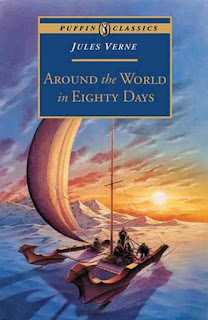
Around the World in Eighty Days - Jules Verne

Image
Published by Puffin Books/Penguin Group: London, England: 1994 (1990). First published in French, 1872. My second Jules Verne book on this blog. I began reading this one, was surprised by the level of humour involved, and decided to keep it to read with Elise once our previous book had been finished. I'm glad I did. Most of us probably have some idea of the plot of Eighty Days , probably through having seen a movie version - the most recent one being the Jackie Chan one - and there are certainly a number of the major beats of those films in the book. But, as is the case with many adaptations of older adventure books, a movie is developed to be more 'cinematic', and therefore bigger in scale than its source material. In terms of Eighty Days, that means that the movie versions cram in more locations and more modes of transport, whereas the book mostly focusses on passenger liner ships and trains. Phileas Fogg also has carefully plotted his course to be the most direct route ...

A Tale of Two Cities - Charles Dickens

Image
Published by Penguin English Library: London, England, 2012. First published 1859. This novel is one of the most well-known Dickens titles, and is the one that Dickens himself believed to be his finest work. It is also, ironically, the least "Dickensy" Dickens novel... Most of the Dickens novels have long chapters with grand flowing sentences, humorous descriptions and heavy layers of satire woven throughout. In A Tale of Two Cities, the humour is there but less present, and the chapters are far shorter. It feels as those Dickens was trying something new for this book - a far more 'edited down' style - and it is obvious from his comments that he was happy with the results. The book is well-written (as all Dickens books are), and the more 'minimalistic' style (comparatively) does suit the tale that is being told - involving romance, rescues, redemption, revenge, and revolution, to list some of the Rs. We meet the forgotten and broken prisoner Doctor Manette, hi...

The Dinosaur Hunters - Deborah Cadbury

Image
Published by Fourth Estate Limited: London, 2000. This non-fiction book follows the lives of some of the early fossil-hunters of England, the first individuals to begin uncovering evidence of the existence of the ancient world. Four of these individuals are highlighted enough to feature on the cover illustration (Richard Owen, Mary Anning, Gideon Mantell and Reverend William Buckland), but two in particular are focussed on in depth: Mantell and Owen.  Mantell is presented as a somewhat tragic figure, devoting his life to the ancient world to the detriment of his own personal and financial security. He is the one who discovers and names two of the three earliest dinosaurs known to the Victorian world ( Iguanadon and Hylaeosaurus ), and he is instrumental in presenting these creatures to the public, yet he continually fails to gain the recognition he deserves, or the financial benefits he needs in order to truly be labelled a success. Misfortune also has its hand in Mantell's life, w...

Saxon: The Book of Dreams - Tim Severin

Image
Published by Pan Books/Macmillan: London, 2013 (2012). Followed by Saxon: The Emperor's Elephant. This book is set in an era I have not often read about, during the rise of Carolus, the king of the Franks who would become Charlemagne. The story follows Sigwulf, the son of a conquered Saxon king, who is sent as 'tribute' to Carolus's court, and befriends Carolus's nephew Hroudland. Sigwulf has eyes that are different colours, and for much of the book hides this fact by wearing an eyepatch. He also is visited on occasion by the fetch (ghost) of his dead twin brother. Yet neither of these facts are really that important to the story, only adding a bit of variety to a character who, otherwise, is a fairly passive figure. He goes from event to event, gaining a lover, growing in influence, becoming an archer and a spy, but most of these things happen to him rather than from his own initiative. I realise that the author is trying to show that Sigwulf must do a lot of these...

White - Ted Dekker

Image
Published in a omnibus edition as "The Circle Trilogy" : " Black "; " Red "; " White ", by Thomas Nelson: Nashville, Tennessee, 2004. In the third novel of this trilogy, Ted Dekker again shifts the allegorical world into a new era of allegory while continuing the 'real world' thriller plot of seeking to undo the effects of the deadly Raison Strain that has been released around the world. Now in the 'other' world Thomas leads a group of 'believers' called The Circle, who are in danger of fracturing into 'denominations' of sorts. The main area of dispute revolves around how to act regarding the Horde (the non-believer equivalents) who seek to destroy the fledgling community. One of Thomas' fellow leaders suggests leaving the Horde to their own devices rather than evangelising them at all, while another suggests 'watering down the gospel' by removing some of the more 'difficult' requirements of...

The Train Robbers - Piers Paul Read

Image
Published by W. H. Allen & Co. Ltd, London, 1978. This is the true story of the various criminals who combined to commit 'The Great Train Robbery' of 1963. We meet the main players and follow their lives as they enter the criminal world, learn why they turned to crime, and what eventually led to their decision to rob a night mail train. The life of crime is not glamourised - we learn very early on that most of their robberies don't pay off - and yet the criminals are seen in a slightly heroic manner. When everything begins to unravel following the robbery, the author points out how few things actually gave them away, and it is interesting to wonder how things could have gone differently and more successfully if the robbers had been slightly more 'fortunate'. There are elements of this story that I find fascinating to read in a non-fiction book, elements such as fake identities, secret plastic surgeries, and corrupt cops. This gives the work an odd 'a...

The Three Musketeers - Alexandre Dumas

Image
Published by Thomas Nelson and Sons Ltd: Great Britain, Date unknown. The second book in 'The D'Artagnan Romances.' Followed by ' Twenty Years After. ' First published in French 1844. A true classic, and one of which many adaptations have been made over the years, The Three Musketeers follows the adventures of Athos, Aramis and Porthos - the "three inseparables" - and their young friend D'Artagnan as they get caught up in the political machinations of France, along with various romantic subplots. Cardinal Richelieu is a nemesis of sorts, though not as directly involved as he is in many of the movie adaptations, while Milady, the Countess de Winter, is a suitably violent and murderous adversary. The important thing to note going in to the book itself is that it is written in an era that has a different basic morality than our own. Certain crimes that we would consider fairly insignificant are seen as 'beyond the pale' to the character...